
Meta Description: Gas stove repair basics can save you time and money. Discover 5 easy hacks to make your stubborn burner work — no handyman required!
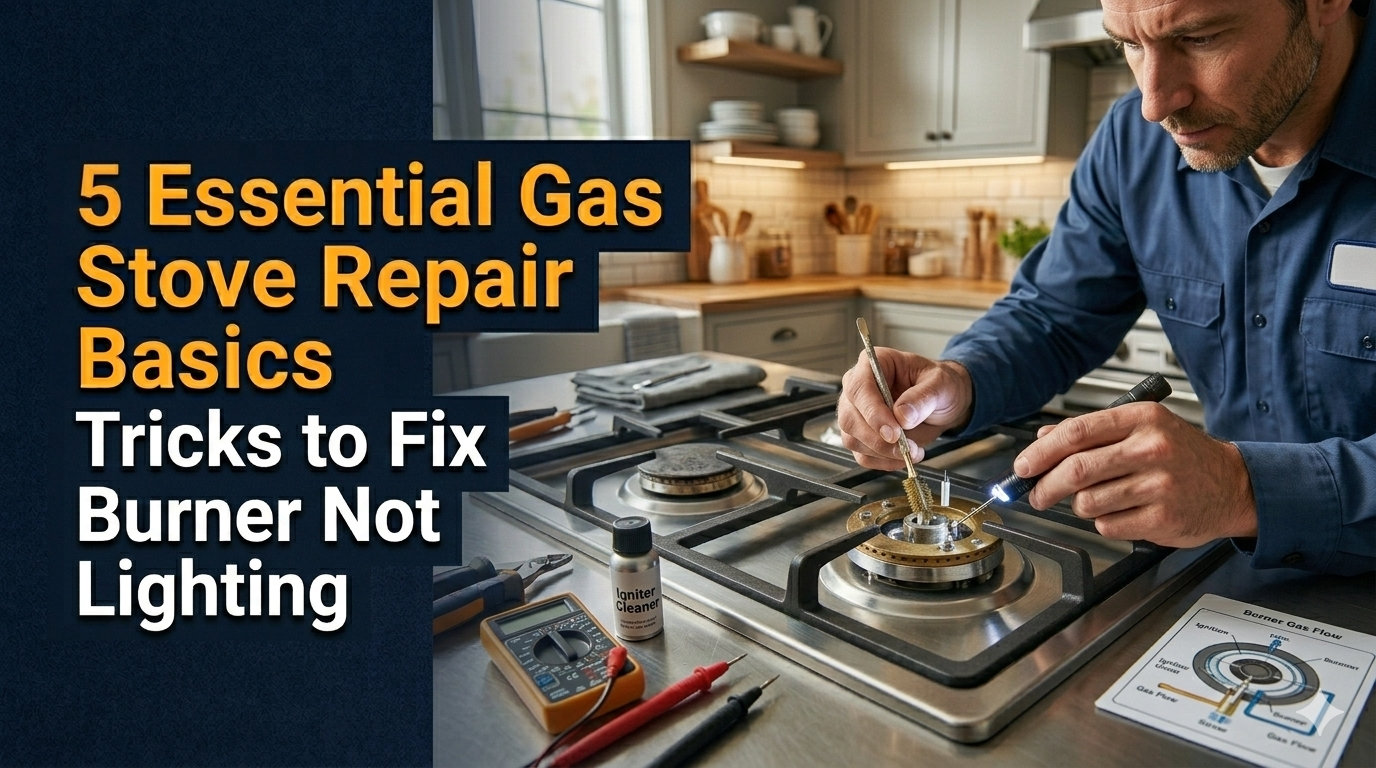
5 Homemade Gas Stove Repair Basics Tricks to Fix Burner Not Lighting
Is your burner on the gas stove not lighting? You turn the knob, hear clicking — but nothing happens. Or maybe there’s just no click at all. It’s maddening — especially when you’re trying to make dinner.
The good news? Most burner troubles are easier to fix than you think.
You don’t always have to call a repairman. With some basic tools and a little know-how, you can make simple gas stove fixes all at home. This guide takes you through 5 things to know about gas stove repair basics that will help you get your burner lighting again — safely and quickly.
Let’s dive in.
Why Your Gas Burner Stops Lighting in the First Place
Before we jump into the fixes, it’s useful to understand why this happens.
There are a few common reasons why gas burners stop lighting. Food debris and grease clog the burner ports. The igniter gets wet when cleaning. The igniter ages over time just by sitting there. Sometimes there is a problem with gas supply.
Here’s a quick overview:
| Cause | How Common | DIY Fix? |
|---|---|---|
| Clogged burner ports | Very common | Yes |
| Wet or dirty igniter | Very common | Yes |
| Faulty igniter | Common | Yes (with part) |
| Loose wiring | Less common | Yes (carefully) |
| Gas supply issue | Rare | Call a professional |
Usually it’s something simple — dirt, moisture, or a worn part. Let’s fix it step by step.
Safety First: Before You Touch Anything, What to Do
This is the number one item on any gas stove repair basics guide. Safety comes before everything else.
Before starting, always follow these steps:
- Make sure that all the burner knobs are completely off.
- Check to be sure the stove is cool to the touch.
- If you smell gas, DO NOT use your stove. Open windows, exit your home, and call your gas company immediately.
- If the stove has electric ignition, unplug it from the wall outlet.
- Have a fire extinguisher handy in case of emergencies.
Gas stoves combine electricity and combustible gas. That combination demands respect. When you adhere to basic safety precautions, you will be okay.
Trick #1 — Give the Burner Caps and Ports a Deep Clean
This is the most common fix for burners that won’t light. It fixes the issue more frequently than anything else.
Why Dirty Burners Stop Lighting
Whenever you cook, little food splatters, grease, and liquid spills land around the burner. Over time, this gunk accumulates in the burner ports — the tiny holes where gas escapes. When those holes are blocked, gas can’t flow properly. No gas flow means no flame.
It seems simple enough, but this one problem causes the most burner lighting issues.
What You’ll Need
- Warm water and dish soap
- An old toothbrush or soft brush
- A toothpick or a straightened paper clip
- A dry cloth or paper towels
Step-by-Step Cleaning Process
Step 1: Take off the burner grate (the metal rack that sits on top).
Step 2: Remove the burner cap. It just sits on top — no screws.
Step 3: Examine the burner head below. There will be tiny holes along the edge. These are the ports.
Step 4: Take your toothpick or paper clip and use it to prod the visible debris out of each port. Do not break the toothpick off inside — that complicates everything.
Step 5: Prepare a solution of warm water and a few drops of dish soap. Dip your toothbrush in and gently scrub the burner cap and burner head.
Step 6: Rinse with clean water. Shake off excess moisture.
Step 7: Allow everything to air dry fully — at least 30 minutes. Or use a dry cloth to speed the process up.
Step 8: Reassemble and test.
Pro Tip
Never use a metal wire brush on the burner. It can scratch the surface and damage the ports. Stick to a soft toothbrush.
Most burners will ignite again as soon as you’re done cleaning them. If it still doesn’t, proceed to Trick #2.
Trick #2 — Properly Dry Out the Igniter
If you recently cleaned your stove and the burner won’t light, moisture is almost definitely to blame.
How Moisture Kills the Igniter
The igniter is a small white or ceramic part next to the burner. It generates the spark that ignites the gas. When water comes into contact with it — from cleaning, boiling over, or even humidity — it can’t spark properly.
You may hear the clicking sound keep going without stopping even when the knob is switched off. That’s a standard indicator of a wet igniter.
Two Ways to Dry It Out
Method 1: Air Drying Simply leave your stove top open and uncovered. Allow it to air dry for 1–2 hours. This works well if you are not in a hurry.
Method 2: Blow Dryer Use a blow dryer on low heat. Hold it approximately 6 inches from the igniter. Run it for 2–3 minutes. This removes moisture quickly without overheating the igniter.
What NOT to Do:
- Do not use a high heat setting on the blow dryer. It can crack the igniter tip.
- Don’t attempt to light the burner while it’s still wet.
- Do not spray anything on the igniter.
Quick Test After Drying
When dry, plug the stove back in and attempt to light the burner. If it sparks and lights — problem solved. If it clicks without sparking, or there isn’t even a click, go on to the next trick.
Trick #3 — Reposition the Burner Cap
This is one that gets skipped all the time. It’s so simple that most people never think to check it.
What the Burner Cap Does
The burner cap sits directly over the burner head. It spreads the gas evenly so that the flame creates a nice, round ring. A slight tilt can throw the gas distribution off completely. The burner may make a clicking sound, you might even catch a glimpse of a little flicker, but it will fail to ignite properly.
How Caps Get Misaligned
- You bump it while cleaning.
- It gets knocked during cooking.
- You put the stove back together in haste and place it slightly off-angle.
It happens all the time.
How to Fix It
Step 1: Take off the burner grate.
Step 2: Examine the burner cap. Check that it’s sitting flat and centered.
Step 3: Lift it off completely.
Step 4: Gently place it back down. Align the notch or groove on the cap with the slot on the burner head. Caps are typically directional.
Step 5: Apply gentle pressure so that it sits flush and flat.
Step 6: Reinstall the grate and attempt to start up the burner.
Visual Check
| Cap Position | What You’ll See | What to Do |
|---|---|---|
| Centered and flat | Even ring of flame | Nothing needed |
| Slightly off-center | Weak or uneven flame | Realign |
| Tilted or raised | No flame, or clicking only | Realign |
| Missing | No flame at all | Replace it |
More often than you’d think, this two-minute fix solves the issue. Don’t skip it.
Trick #4 — Clean or Replace the Igniter
If your burner still won’t light after cleaning and drying, the igniter itself may be dirty or damaged.
Identifying a Dirty vs. Broken Igniter
A dirty igniter is not the same as a dead one. Here’s how to tell them apart:
Dirty Igniter Signs:
- There is a clicking sound, but it is weak
- You see a tiny spark but no flame
- The igniter tip appears brown or coated with residue
Broken Igniter Signs:
- No clicking sound at all
- You can see the igniter tip is cracked or chipped
- Clicking never stops even when the knob is off
Cleaning the Igniter
The igniter tip is fragile. Be gentle.
What you’ll need:
- A dry toothbrush
- A cotton swab
- Rubbing alcohol
Steps:
- Verify that the stove is unplugged.
- Use the dry toothbrush to brush off any loose debris from the igniter tip. Use light strokes.
- Dip a cotton swab in rubbing alcohol.
- Gently wipe the igniter tip. This removes grease and residue.
- Allow to dry thoroughly — at least 15 minutes.
- Plug the stove back in and test.
Important: Never apply water directly to the igniter. Always use rubbing alcohol — it dries quickly and leaves no moisture behind.
Replacing a Broken Igniter
If the igniter tip is cracked and the clicking has completely stopped, you’ll need to replace the igniter module.
According to Consumer Reports’ appliance repair guidance, replacing a faulty igniter is one of the most cost-effective stove repairs a homeowner can do before calling a technician.
Here’s the general process:
- Find your stove’s model number (it will usually be on a sticker inside the oven door or on the back).
- Use that model number to search for a replacement igniter. They are available on Amazon or on appliance parts websites.
- Unplug the stove completely.
- Remove the burner grate and the cap.
- Unscrew the igniter (normally 1–2 screws).
- Disconnect the wire connector underneath.
- Connect the new igniter to the wire.
- Screw it in place.
- Reassemble and test.
Replacement igniters generally cost between $10 and $40. It’s a cost-effective solution compared to a service call.
Trick #5 — Inspect the Burner’s Wiring and Gas Flow
If none of these tricks worked, it’s time to look a little deeper — at the wiring behind the igniter and the seal surrounding the gas inlet.
Checking the Wiring
The igniter attaches via a small wire and connector to your stove’s electrical system. If that connection is loose or the wire is damaged, the igniter won’t receive power.
How to check:
- Unplug the stove.
- Remove the burner grate and the cap.
- Carefully look at the wire running to the igniter.
- Ensure the connector where the wire plugs in is not loose. Press it in firmly.
- Look for visible damage — burns, cuts, or melted plastic on the wire.
If the wire appears damaged, you’ll want to replace it or have an appliance technician do so. Burned wires indicate a larger problem.
If the connector was merely loose, simply pressing it back in firmly may be all that’s needed.
Check the Gas Flow to the Burner
Sometimes the problem isn’t electrical — it’s gas flow.
Quick checks:
- Check that the gas supply valve (often located behind or underneath the stove) is completely open.
- Try a different burner. If all burners have issues, the main gas supply could be the problem.
- Make sure the burner head is sitting firmly in its base. If it’s tilted, gas won’t flow evenly.
When to call a professional:
At any point where you smell gas, stop. Don’t try to fix it yourself. Contact your gas company or a licensed technician. Gas leaks are serious and not a do-it-yourself situation.
When to Know if a DIY Fix Is Enough vs. Calling a Pro
Not all stove troubles require a service call. But some definitely do.
| Problem | DIY Fix? | Call a Pro? |
|---|---|---|
| Clogged burner ports | ✅ Yes | |
| Wet igniter | ✅ Yes | |
| Misaligned burner cap | ✅ Yes | |
| Dirty igniter | ✅ Yes | |
| Loose wire connector | ✅ Yes (carefully) | |
| Cracked igniter tip | ✅ Yes (replace part) | |
| Damaged wiring | ✅ Yes | |
| Gas smell | ✅ Yes — immediately | |
| No gas from multiple burners | ✅ Yes | |
| Regulator or valve issue | ✅ Yes |
Use this table as your guide. When in doubt, call a pro. It’s better to be safe.
Maintain Your Burners: Best Maintenance Habits
Prevention is better and cheaper than a repair. These simple habits will keep your gas burners lighting beautifully for years.
Weekly Habits
- Wipe down the stovetop after every use while it is still a bit warm.
- Wipe up spills right away before they dry and harden.
- Remove the burner grates once a week and rinse them.
Monthly Habits
- Perform a complete burner cap and port clean (similar to Trick #1).
- Visually inspect the igniter tips for any buildup or damage.
- Check that all burner caps are seated properly.
Every 6 Months
- Clean the full stovetop area thoroughly.
- Visually check wiring for any signs of wear.
- Test each burner and make a note of any that are performing weakly.
A clean stove is a stove in working order. Don’t wait until a problem manifests to begin addressing it.
Frequently Asked Questions: Gas Stove Repair Basics
Q1: My gas burner clicks but doesn’t ignite. Why? That usually means the igniter is receiving power but isn’t sparking strongly enough to ignite the gas. Common causes are a wet igniter, dirty igniter tip, or a clogged burner port. First, dry it and clean it up — see Tricks #1 and #2.
Q2: Why does my stove keep clicking even when it’s off? Almost always this is caused by moisture on the igniter. It creates a loop that continues to trigger the clicking. Use a blow dryer on low to dry out the igniter and the issue should stop.
Q3: Can a gas stove be repaired safely without the help of an expert? Yes, for basic repairs like cleaning and changing igniters. As long as you unplug the stove before getting to work and detect no gas smell, most of these tricks are perfectly safe for a homeowner to perform.
Q4: What is the cost for a replacement igniter? Replacement igniters generally range from about $10 to $40 depending on the brand and model of your stove. You can buy them on Amazon, appliance parts websites, or at some hardware stores.
Q5: What if only one burner doesn’t ignite but the others are functioning well? That indicates an issue with that individual burner — probably a blocked port, misaligned cap, or faulty igniter. Work through the 5 tricks in this article starting with Trick #1.
Q6: Can pieces of food actually prevent a burner from lighting? Absolutely. Even a small piece of food or a drop of dried residue blocking a burner port will keep gas from flowing like it should. That is the most common reason that burners don’t light.
Q7: How frequently should I be cleaning my gas burners? Give burner caps and ports a basic clean once a month. Perform a deeper clean every 3–6 months — or whenever you see a burner flame appearing uneven or weak.
Wrapping It All Up
A gas burner that refuses to light is one of the most frequent kitchen problems — but also one of the most fixable.
In most cases you can fix the problem yourself by running through these five essential gas stove repair basics tricks:
- Deep clean the burner caps and ports — get rid of the gunk clogging the gas pathway.
- Dry out the igniter — moisture is an invisible enemy more often than you’d think.
- Reposition the burner cap — a slight tilt is all it takes to stop a flame.
- Clean or replace the igniter — a worn-out tip can’t create a spark.
- Check wiring and gas flow — a loose connector or blocked gas line could be the missing piece of the puzzle.
These tricks don’t need expensive tools or professional training. They simply need a little patience and attention to detail.
Of course, always stay safe. If you smell gas, avoid troubleshooting — evacuate and call your gas company. But for the vast majority of lighting issues, now you have everything you need to repair it yourself.
Now, go give those burners another whirl. Dinner’s waiting.

