
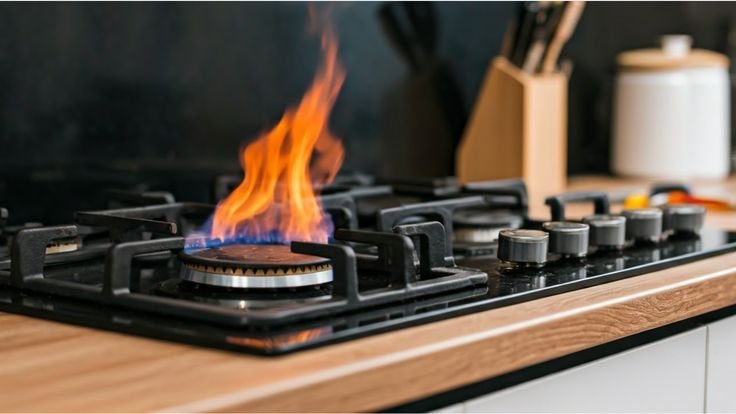
Let me tell you about the morning I almost skipped breakfast because my gas stove just refused to cooperate.
I turned the knob, heard that familiar clicking sound — tick, tick, tick, tick — and nothing. No flame. Just an empty burner staring back at me while my eggs sat waiting on the counter. I tried again. Still nothing. I’m not a professional technician, but I’ve been cooking on gas stoves my whole life, and that morning I decided I was going to figure this out myself before calling anyone.
Spoiler: I fixed it in about 20 minutes. No technician. No expensive service call.
If your gas stove burner is giving you trouble — clicking but not lighting, producing a weak or uneven flame, or just flat-out refusing to ignite — this guide is for you. I’ve been through most of these issues firsthand, and I want to share what actually worked, not just textbook advice.
1. The Burner Won’t Ignite — And It’s Probably Not What You Think
Most people immediately assume a gas problem when a burner won’t light. I did too. But nine times out of ten, the issue is something much simpler: a dirty or wet burner cap.
Here’s what happens. When you cook, food particles, spilled liquids, and grease slowly build up around the burner cap and its ports (those little holes where the flame actually comes out). Over time, these ports get clogged, and the gas can’t flow properly. No gas flow, no ignition.
What to do:
- Turn off the stove completely and let everything cool down.
- Remove the burner grate, then lift off the burner cap — it usually just sits on top.
- Look closely at the ports around the edge of the cap. If they look clogged or discolored, that’s your culprit.
- Use a toothpick or a straightened paper clip to gently clear each port. Don’t use a toothbrush yet — you want to loosen the debris first.
- Then scrub with a small brush dipped in warm soapy water.
- Dry completely — and I mean completely — before putting it back.
I’ve made the mistake of putting a slightly damp burner cap back and wondering why it still wouldn’t light. Water blocks ignition just as effectively as grease does.
If you’ve been dealing with repeated ignition failures, it’s worth reading through 7 Powerful Gas Stove Repair Basics Ideas to Fix Ignition Problems — some really practical detail in there that goes beyond the basics.
2. The Igniter Keeps Clicking Even When the Stove Is Off
This one is genuinely annoying. You’ve turned off the burner, but that clicking sound just keeps going — tick, tick, tick, tick. It sounds like your stove has developed a nervous habit.
I dealt with this for about two weeks before figuring out the cause. The igniter was wet.
This usually happens after a boil-over or after cleaning the stove with too much water. The moisture seeps into the igniter mechanism and causes it to misfire repeatedly.
The fix:
- Don’t panic — this is almost never a sign of serious damage.
- Remove the burner cap and grate, and let the area air-dry for a few hours.
- If you’re in a hurry, use a hair dryer on the low heat setting to gently dry around the igniter (keep it moving — don’t concentrate heat in one spot).
- If drying doesn’t stop the clicking within an hour, check whether any food debris has gotten into the igniter electrode (the small ceramic piece with a metal tip). Clean it gently with a dry cloth or cotton swab.
| Cause of Continuous Clicking | Quick Fix |
|---|---|
| Moisture from boil-over | Air dry or use hair dryer (low heat) |
| Food debris on electrode | Clean with dry cotton swab |
| Misaligned burner cap | Reseat cap properly |
| Faulty igniter switch | May need professional help |
In most cases, drying and cleaning solves it. If it continues for more than 24 hours after thorough drying, you might have a faulty igniter switch — and that’s when I’d recommend calling a technician.
3. Weak Flame — When Your Stove Is Cooking Like It Gave Up
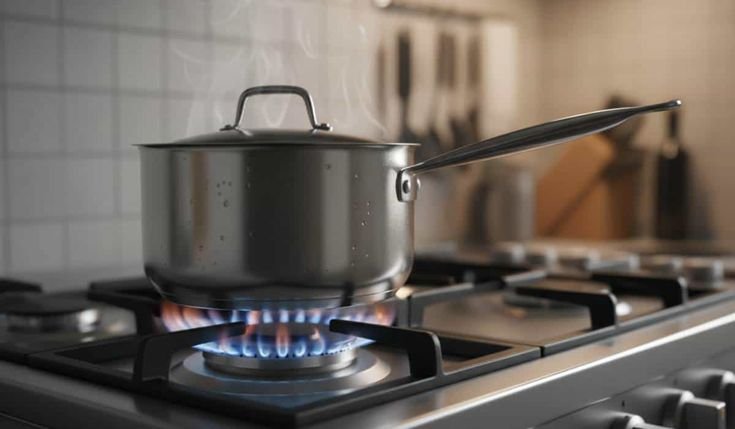
A weak, lazy flame that barely heats a pan is one of the most frustrating burner issues. Your cooking time doubles, your food ends up unevenly cooked, and you start questioning whether your stove is dying.
It’s usually not dying. It’s just blocked.
Weak flame almost always comes back to the same thing: partially clogged burner ports. Unlike a completely blocked port that prevents ignition entirely, a partially clogged one lets some gas through — just not enough.
Step-by-step fix:
- Turn everything off and let the stove cool.
- Remove the burner cap and head.
- Use a straightened paper clip to clear each port individually. Go slowly — you want to make sure each port is fully open.
- Soak the burner head in warm soapy water for about 15 minutes.
- Rinse thoroughly, then dry completely.
- Reassemble and test.
Here’s something I learned the hard way: if you only clean some of the ports and leave others blocked, you get an uneven flame — high on one side, low or absent on the other. That uneven cooking is actually its own problem (and I cover that below), but the fix starts the same way.
Also worth checking: the gas pressure. If all your burners suddenly seem weak at the same time, the issue might be with your gas supply line or regulator, not the stove itself. That’s a job for a gas professional.
For a deeper look at this, 8 Essential Gas Stove Repair Basics Steps to Fix Weak Flame covers some angles I hadn’t considered, including the regulator issue.
4. Uneven Flame — One Side Burns High, the Other Barely Registers
Picture this: you’re trying to heat a pan evenly, but one half of the burner has a strong blue flame while the other side is barely there. Your food ends up partially burned and partially undercooked.
This used to happen to me constantly until I realized the burner cap wasn’t sitting correctly.
Two main causes — and how to fix each:
Cause A: Misaligned burner cap
The burner cap needs to sit perfectly flat and centered over the burner head. Even a small tilt causes gas to distribute unevenly.
- Remove the cap, clean everything underneath, and replace it carefully.
- Press it gently to make sure it’s fully seated and level.
- Turn on the burner and check the flame distribution before putting the grate back.
Cause B: Partially clogged ports
As mentioned earlier, if some ports are blocked and others aren’t, the flame will be inconsistent.
- Follow the same port-clearing steps from Fix #3.
- Pay extra attention to ports on the weaker side of the flame.
| Symptom | Likely Cause | Fix |
|---|---|---|
| Flame only on one side | Burner cap tilted | Reseat the cap flat |
| Some ports no flame | Clogged ports | Clear with paper clip + soak |
| Flame lifts off burner | Gas pressure too high | Check regulator |
| Flame orange/yellow | Incomplete combustion | Clean burner, check air shutter |
One thing that surprised me: an orange or yellow flame (instead of the healthy blue) is actually a sign that something is off with the air-to-gas mixture, not just a blockage. It could mean the air shutter near the burner needs adjustment — or it could indicate carbon monoxide risk. If cleaning doesn’t turn your flame back to blue, don’t ignore it.
5. Burner Lights But Immediately Goes Out
This one drove me absolutely crazy for a while. The igniter sparks, the flame pops on, you take your hand off the knob — and the flame dies immediately. You try again. Same thing. You end up holding the knob down for 30 seconds just to keep it going, and the moment you let go, it dies.
There are two likely causes here:
Cause 1: The thermocouple or flame sensor isn’t working properly
Newer gas stoves have a safety feature called a thermocouple (or thermocoupler/flame sensor) — it’s a small device that detects whether a flame is actually present. If it doesn’t sense heat quickly enough, it cuts the gas as a safety measure.
Sometimes the thermocouple gets coated with grease or residue and can’t detect the flame properly.
- Clean the thermocouple (the small metallic probe near the burner) gently with fine steel wool or emery cloth.
- Don’t scrub hard — just remove the residue coating.
- Test again after cleaning.
Cause 2: The burner cap isn’t seated properly
A misaligned cap can cause the flame to not wrap around the thermocouple properly, meaning it never gets detected.
- Remove and reseat the cap as described in Fix #4.
If neither of these works and you’re still holding the knob down for extended periods just to maintain a flame, the thermocouple itself may need replacing. That’s a relatively inexpensive part, but if you’re not comfortable with appliance repair, it’s worth having a technician handle it.
6. The Gas Smell Without a Flame — Don’t Ignore This One
I want to address this separately because it’s the one situation where you should not try to troubleshoot yourself first.
If you smell gas around your stove and there’s no flame present — or if the smell persists after you’ve turned everything off — that’s a potential gas leak, and it needs to be treated seriously.
What to do immediately:
- Don’t turn any electrical switches on or off (even light switches can create a spark).
- Don’t use your phone near the stove.
- Open windows and doors to ventilate.
- Turn off the gas supply at the main valve if you know where it is.
- Leave the house and call your gas company from outside.
Now, not every gas smell is a serious leak. Sometimes you get a faint smell when a burner doesn’t ignite and a small amount of gas has escaped — that’s normal and should dissipate quickly with ventilation. The issue is when the smell is strong, persistent, or you can’t identify a clear source.
For ongoing safety awareness, it’s worth going through 5 Powerful Gas Stove Repair Basics Safety Tips That Prevent Gas Leaks — it helped me understand the difference between a minor gas burp and an actual leak situation.
Common Mistakes People Make (Including Me)
Here are a few things I’ve done wrong that I’d rather you avoid:
Reassembling while still wet. It seems obvious in hindsight, but I’ve put burner components back while they were still slightly damp more times than I’d like to admit. The result is always the same: the burner doesn’t light, I panic, then I realize I just need to dry it properly.
Using sharp metal tools to clean ports. I once used a thin wire to clear burner ports and accidentally widened one of them. That burner never had quite the same flame pattern again. Stick to wooden toothpicks or paper clips for clearing ports, and brushes for cleaning.
Ignoring the alignment. The burner cap has to sit perfectly flat. I’ve spent 45 minutes troubleshooting a “broken” igniter when the only problem was that the cap was sitting slightly off-center.
Assuming all burner problems are gas problems. Probably 80% of common burner issues come down to cleanliness and alignment — not gas supply. Before you call anyone or assume something is seriously wrong, clean and realign first.
Skipping regular maintenance. The best troubleshooting is preventing problems in the first place. A quick wipe-down of burner caps and ports every couple of weeks takes five minutes and saves hours of frustration.
A Quick Reference: Which Fix for Which Problem
| Problem | First Thing to Check | Likely Fix |
|---|---|---|
| Burner won’t ignite | Burner cap ports | Clean and dry thoroughly |
| Constant clicking sound | Moisture around igniter | Dry the igniter area |
| Weak flame | Partially clogged ports | Clear all ports, soak cap |
| Uneven flame | Cap alignment + ports | Reseat cap, clear ports |
| Flame lights then dies | Thermocouple / cap seating | Clean thermocouple, reseat cap |
| Gas smell without flame | Potential leak | Ventilate, turn off gas, call provider |
Final Thoughts
Most gas stove burner problems are fixable without a service call, and they almost always come back to the same root causes: debris, moisture, or misalignment. The tools you need are usually already in your kitchen — a toothpick, a small brush, some soapy water, and a bit of patience.
The thing that changed my approach to stove maintenance was stopping treating it as reactive (fix it when it breaks) and starting to clean the burner components regularly. Once I started doing that, the ignition failures and weak flames became rare exceptions rather than weekly frustrations.
That said, know your limits. Gas appliances command respect, and if you’re ever unsure — especially with persistent gas smells or electrical igniter faults — a professional is always worth the cost.
Also worth reading: 9 Easy Gas Stove Repair Basics Troubleshooting Steps Anyone Can Try — it covers a broader range of stove issues that go beyond just the burner, including oven problems and control knob issues that often get overlooked.

