
Meta Description: Gas stove repair basics can save you time and money. Learn 6 powerful steps to fix ignition failure at home safely and effectively.
Gas Stove Won’t Ignite? Here Are 6 Steps to Repair
Have you ever gone to cook dinner, turned the burner knob and heard that dreaded clicking sound — but no flame? It’s one of the more frustrating moments in the kitchen. And it always seems to come at the worst moment.
The good news? The majority of ignition failures are not serious. In fact, most of them can be repaired at home without hiring a technician. You just have to know the process.
The following guide takes you through 6 gas stove repair basics that will arm you with the knowledge to diagnose and repair ignition failure like a pro. Whether your stove’s clicking forever, not clicking at all or just lighting intermittently, this has you covered.
Let’s get into it.
Why Your Gas Stove Won’t Light — The Short Version
Before trying to fix them, it can help to understand what causes ignition failure in the first place.
Your gas stove is designed to ignite the fuel that flows from the burner with a spark igniter. Turn the knob, gas flows and then the igniter sparks. That spark ignites the gas, and you have a flame.
If something disrupts that sequence — no flame.
Below are some of the most common culprits:
| Cause | How Common | DIY Fix? |
|---|---|---|
| Dirty burner or igniter | Very Common | Yes |
| Wet or moist igniter | Common | Yes |
| Misaligned burner cap | Common | Yes |
| Faulty igniter switch | Moderate | Yes (with care) |
| Damaged spark module | Less Common | Possible |
| Gas supply issue | Rare | Check only |
Most of these issues are easily resolved with simple tools and a little patience. Now, let’s cover the actual steps.
Step 1 — Turn Off the Power and Gas Before You Touch Anything
This is rule No. 1 in every guide to gas stove repair basics — and for good reason.
Gas appliances can be dangerous if not handled properly. Unplug the stove from the wall outlet before you open anything. Most igniters are electric, which means the stove requires power to spark. It also means electricity is coming into play, not just gas.
Once done, close the gas supply valve. It’s typically found at the rear or bottom of a stove. Move it to the “off” position.
Why this matters:
- Prevents accidental sparking
- Reduces risk of gas leaks
- Helps protect you when cleaning or working on the internals
If you recently used the stove, allow it a few minutes to cool off before this step. Burners retain heat longer than you might expect.
What Tools You’ll Need
You don’t require a toolbox stuffed with equipment. Here’s a simple list:
- Soft-bristle toothbrush
- Mild dish soap
- Warm water
- Dry cloth or paper towels
- Needle or pin (to unclog a path)
- Flathead and Phillips screwdrivers
- Multimeter (optional, useful for igniter testing)
Getting these together ahead of time eliminates a lot of back-and-forth.
Step 2 — Give the Burner Caps and Heads a Good Scrub
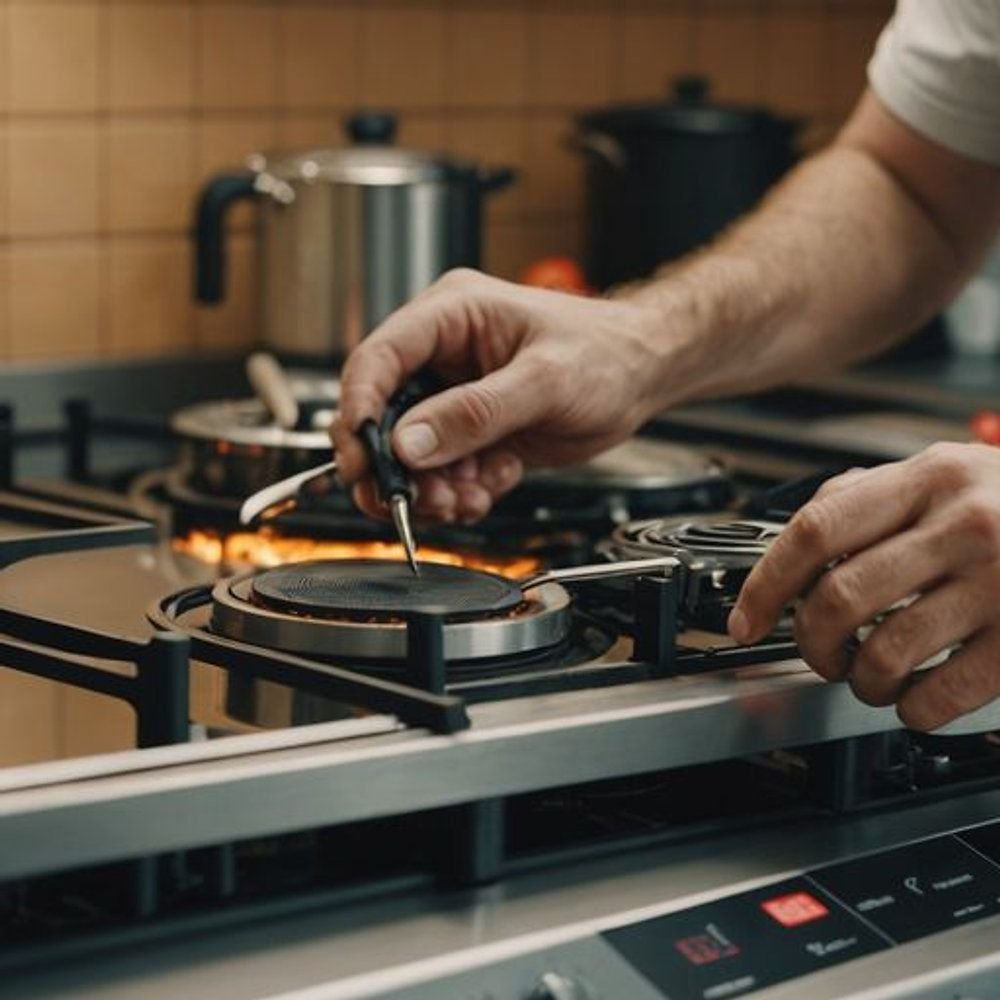
Here’s a fact that most people do not know: a dirty burner is the number one cause of failure to ignite. Grease, food debris and spilled liquids collect in the burner ports and restrict the gas flow. Without flow, there will be no flame — even if your igniter is operating perfectly.
In most cases, this is sufficient to fix the issue.
How to Remove the Burner Cap
Lift the grate off the stove. Then just lift the burner cap — it often comes off without any tools. Beneath that is the burner head, which may be a star or ring shape and where gas actually shoots out.
Remove both pieces carefully.
Cleaning the Burner Head
Look at the small holes around the edge of the burner head. These are ports where gas runs through. If they’re clogged, gas cannot flow through them properly.
Follow these cleaning steps:
- Let the burner head soak in warm, soapy water for 20–30 minutes.
- Scrub with a soft-bristled toothbrush to remove grease and buildup.
- Gently poke through the clogged ports with a needle or pin.
- Rinse thoroughly with clean water.
- Let it dry fully in the air — or use a dry cloth.
Never use a toothpick. It can break inside the port and worsen the clog.
Cleaning the Burner Cap
Clean the burner cap with a damp cloth and mild soap. For grease, check the underside — that’s where it likes to hide.
Check to ensure that no food is stuck inside any crevices or ridges.
Put both parts aside and proceed to the next step once they’re clean and dry.
Step 3 — Check and Dry the Igniter
That little ceramic or metal tip you see close to the burner is the igniter. It’s the part that creates the spark.
Water is among its worst enemies.
If you’ve recently scrubbed your stove, boiled over a pot, or live in a humid area, moisture can work its way into the igniter so that it doesn’t spark. This is one of the most underdiagnosed problems in gas stove repair basics.
How to Check the Igniter
Look at the igniter closely. It’s a small white or cream-colored ceramic piece with a metal tip. Signs of trouble include:
- Visible moisture or discoloration
- Black soot accumulation on the tip
- Cracks in the ceramic
If it seems wet or dirty, that’s your issue.
Drying the Igniter
Here’s the easiest repair you’ll ever make:
- Gently pat around the igniter with a dry cloth.
- Set your oven at a low temperature (about 200°F / 93°C) for 10–15 minutes to assist in moisture evaporation — only if the stove is otherwise operable.
- Alternatively, use a hair dryer on low, holding it a few inches from the igniter for 2–3 minutes.
- Do not attempt to light until 15 minutes have passed.
Cleaning Carbon Buildup
If there’s black residue on the igniter tip, gently brush it with a dry toothbrush. Do not use water directly on the igniter — moisture is just what you’re trying to remove.
Some technicians will dab a bit of rubbing alcohol on a cotton swab and clean the tip. It evaporates quickly and will not leave moisture behind.
Step 4 — Properly Place the Burner Cap
This is one of those little things that leads to big trouble.
The burner cap can become dislodged when the stove is cleaned or bumped. Even a slight misalignment can cause the burner to fail to properly ignite. The gas is capable of flowing, but the spark cannot reach it properly.
How to Check the Alignment
Set the burner head back onto its base. Next, set the burner cap on top. It should lie flat and level, without wobbling.
Most burner caps have a notch or groove that aligns with a slot on the burner head. Make sure they’re lined up.
Signs of misalignment:
- The cap wobbles or rocks
- You can see a gap on one side
- The burner sparks but does not light
Getting It Right
Press down gently on the cap and rotate it slightly until it settles into place. It should feel steady and flat.
This is especially important to do after a deep clean, as it’s easy to put parts back in without checking alignment during the process.
A properly aligned burner cap makes a surprisingly big difference. Many people go through a full stove repair without even realizing this was the problem all along.
Step 5 — Test the Igniter Switch and Replace if Necessary
If you’ve cleaned and repositioned everything, and your stove still won’t ignite, it’s time to inspect the igniter switch.
The igniter switch is under the knob for each burner. When you turn or press the knob, it activates the switch that tells the igniter to spark.
A defect in the switch means no signal — and no spark.
How to Test the Switch
This step takes a little more confidence but is still easily done at home.
First, pull straight out on the control knob to remove it. You will see the switch mechanism behind it.
Look for:
- Burn marks or melted plastic
- Corrosion or rust
- Loose or disconnected wires
If the switch itself appears damaged, it would likely need replacing.
Using a multimeter for a more accurate test:
- Switch the multimeter to continuity mode.
- Place the probes on each of the switch’s terminals.
- Press or activate the switch.
- If you do not get a reading (or hear no beep), the switch is faulty.
Replacing the Switch
Igniter switches are model-specific to the stove. Look up your stove’s model number (usually located inside its door or on its back panel), then search for the corresponding replacement part online.
Replacement switches are typically inexpensive — often less than $20.
To install:
- Detach the wires from the old switch (take a picture first, so you remember how it was arranged).
- Snap or screw the new switch into place.
- Reconnect the wires.
- Test the burner.
If you’re not comfortable with this step, this is a good place to call in a licensed technician. Plenty of homeowners get by just fine with a bit of patience.
Step 6 — Inspect the Spark Module and Check Gas Supply
If you’ve tried all five steps above and the burner still won’t light, there are two last things to check: the spark module and the gas supply itself.
What Is the Spark Module?
The spark module serves as the central control unit for all of your stove’s igniters. When you turn on any burner, the spark module sends electrical signals to the igniters.
A faulty module can result in no ignition at all — or constant sparking even if you haven’t touched a knob.
Signs the Spark Module Has Failed
| Symptom | What It Might Mean |
|---|---|
| No clicking sound from any burner | Module may be dead |
| Constant clicking even when off | Module stuck in active mode |
| Only one burner fails | Likely not the module |
| All burners fail at once | Module is suspect |
The spark module is typically located inside the stove, behind the control panel. You can replace it, but it requires more work than the previous steps. If you’re uncomfortable with appliance wiring, call a repair professional at this point.
Checking the Gas Supply
In some cases, the problem isn’t even with the igniter — it’s the gas.
Check these things:
- Make sure the gas valve behind the stove is fully open
- Are other gas appliances in your house operating?
- Is there a gas outage in your area?
If your gas supply is fine but the burner still fails to light when the igniter sparks, you may have a blocked or damaged gas valve on the stove itself. That’s the work of a professional.
According to the U.S. Consumer Product Safety Commission, gas appliance repairs involving supply lines or valves should always be handled by a licensed technician to prevent serious hazards.
Never attempt to fix gas valves or gas lines on your own. This falls into licensed technician territory for safety.
Gas Stove Repair Basics: Quick Reference
Here’s a summary of all six steps in one easy table:
| Step | Action | Tools Needed | Fixes |
|---|---|---|---|
| 1 | Cut power and gas | None | Safety first |
| 2 | Clean burner caps and heads | Toothbrush, soap, pin | Clogged ports |
| 3 | Dry and clean igniter | Cloth, toothbrush | Moisture, carbon |
| 4 | Realign burner cap | Hands only | Misalignment |
| 5 | Test/replace igniter switch | Multimeter, screwdriver | Faulty switch |
| 6 | Check spark module and gas | Multimeter | Module or supply issues |
Do It Yourself, or Hire a Pro?
Gas stove repair basics are genuinely useful for home repairs. But there are limits.
Call a licensed appliance technician if:
- You smell gas at any point during the process
- You see damage to gas lines or connectors
- There are electrical burn marks found inside the stove control panel
- You have replaced the igniter and module and still have no ignition
- You are unsure about any wiring step
Gas leaks are serious. If you ever smell gas strongly, do not attempt to fix anything. Get out of the house immediately, do not touch any switches or flames, and contact your gas company or emergency services.
What Can You Do to Prevent Ignition Failure in the Future
Once you’ve resolved the issue, some regular maintenance goes a long way.
Monthly tasks:
- Clean burner caps and grates after heavy use
- Inspect for food residue around the igniter
Every 3–6 months:
- Full burner deep clean (soak and scrub)
- Make sure all knobs are turning freely
Yearly:
- Check igniter tips for wear or corrosion
- Check that wires near the control panel have not been damaged
Good habits prevent 90% of ignition issues before they even start.
Common Gas Stove Repair Questions: FAQ
Q1: Why is my gas stove clicking but not lighting? This typically indicates that the igniter is functional but gas isn’t reaching it. The most probable culprits are a blocked burner port, a misaligned burner cap or a closed gas valve. Begin with Step 2 in this guide.
Q2: What if only one burner isn’t working — can I still use my stove? The other burners are usually independent, yes. But you should have the faulty burner repaired fairly soon, as that problem can spread or signal a larger issue developing.
Q3: Is cleaning the igniter with water okay? No. Water can short out circuits and cause moisture-related ignition failure. Instead, use a dry toothbrush or a cotton swab with rubbing alcohol.
Q4: What is the cost to replace an igniter? The igniter part itself costs just $10–$50, depending on the stove’s brand and model. Professional labor adds another $100–$200 on top of that. DIY saves significant money here.
Q5: Why is my stove clicking all the time even when no burner is on? This is typically due to moisture under the burner cap or a jammed igniter switch. Make sure the area is dry, and check to see if the cap is seated properly.
Q6: How long do gas stove igniters last? In daily use, most igniters will last 5–10 years. Intensive use or lack of maintenance can greatly reduce their lifespan.
Q7: What if all my burners stop working simultaneously? If all of the burners fail at once, the problem is probably with the spark module or the power supply to the stove. Make sure the stove is plugged in properly, then inspect the spark module.
Wrapping It All Up
Ignition failure sounds serious — but as you’ve seen, it’s usually something relatively easy to fix. A clogged burner port, a wet igniter or even a slightly misaligned cap can prevent your stove from lighting.
By following these 6 gas stove repair basics steps, you are able to diagnose the problem, fix it safely and return to cooking without forking over money on a service call.
To recap:
- Always disconnect gas and power before anything else
- Deep-clean burner caps and heads
- Dry and clean the igniter
- Realign the burner cap properly
- Test or replace the igniter switch
- Check the spark module and gas supply
Tackle them in order, and most ignition problems will be solved by step four. In most cases, the whole process takes less than an hour.
Gas stove repair basics are a skill every homeowner should know. Once you’ve done it once, you’ll feel confident repeating it in the future — and saving money every single time.

