
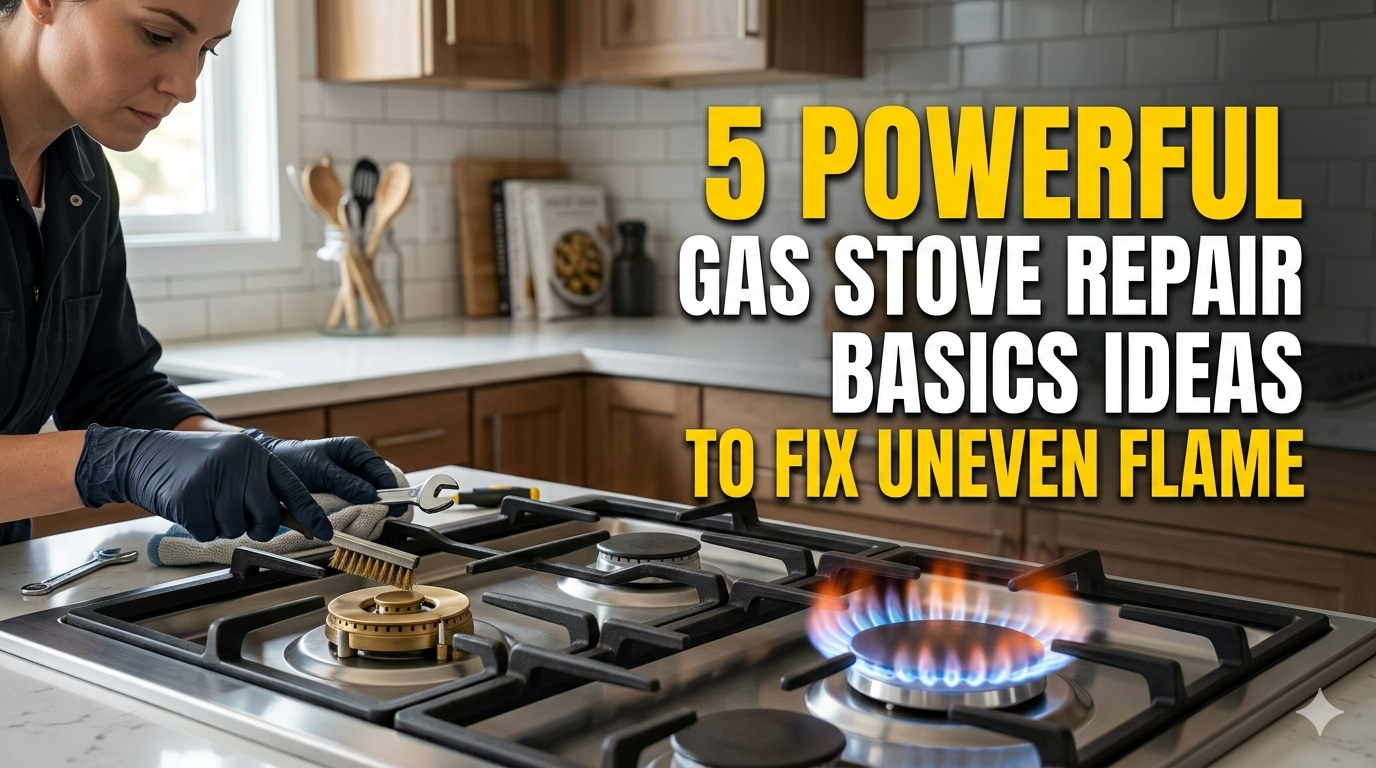
Meta Description: Gas stove repair basics can save you time and money. Read on for 5 strong concepts that absolutely will remedy irregular fires and keep your stove cooking at home.
5 Super Gas Stove Repair Basics Plan To Fix Uneven Flame
Have you ever attempted to whip up a perfect omelet, only to have one side burn while the other remains raw? That’s what an uneven flame does to your cooking — and your patience.
One of the most common kitchen problems is an uneven flame on your gas stove. The good news? You don’t have to always call a technician. Most flame problems on a gas range can be safely and quickly fixed yourself, with the right repair basics.
This guide will show you 5 practical repair ideas that really work. Whether your flame sputters, leans sideways, or hardly appears at all, there’s a solution for you here.
Let’s get into it.
Why Your Gas Stove Flame Gets Uneven in the First Place
Before trying to fix anything, find out why the problem exists.
Your gas stove burns fuel through small ports — little holes in the burner head. When those ports are blocked, dirty, or damaged, gas can’t flow uniformly. The result? A flame that shoots to one side, sputters, or comes out weak.
Here are the most common reasons:
| Cause | What Happens |
|---|---|
| Clogged burner ports | Flame visible only on one side |
| Food debris in the burner cap | Uneven or yellow flame |
| Misaligned burner cap | Flames tilt or lift off the burners |
| Moisture or water damage | Flame flickers or doesn’t stay lit |
| Gas pressure issues | Weak, lazy flame across all burners |
| Worn igniter | Delayed ignition or uneven startup |
Many of these issues are solvable at home. All you need is the correct approach.
Safety First — Always Do This Before Touching Anything
This part is non-negotiable.
Working on a gas stove without taking proper safety precautions is dangerous. Before you touch a single burner, do these:
- Turn off all burners. Check all knobs and ensure they are in the OFF position.
- Disconnect the power. Disconnect the stove from the wall plug.
- Shut off the gas supply. Find the gas valve in the back or under your stove. Turn it off.
- Allow the stove to completely cool down. Never work on a hot burner.
- Open a window. It ensures you are safe from any residual gas smell.
- Keep a fire extinguisher nearby. Just in case.
If you smell gas at full strength, shut everything off, get out of the house, and call your gas company immediately. Don’t try to fix it yourself.
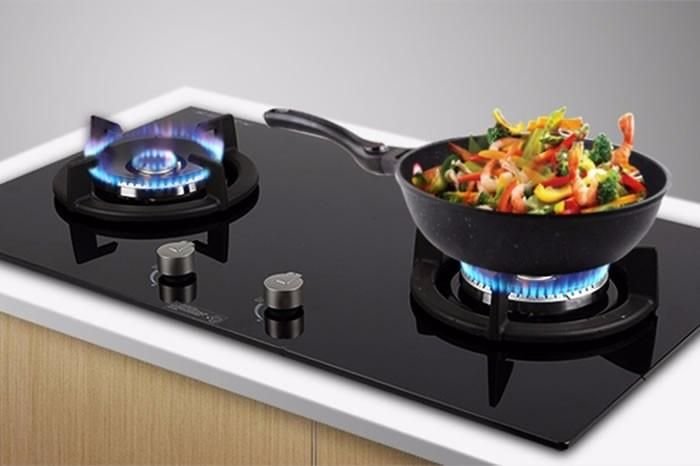
Idea #1 — Professional-Level Cleaning of the Burner Ports
This is the most frequent fix — and the most overlooked one.
Burner ports are small holes encircling the burner head. Grease, food spills, and cooking residue build up in them over time. When certain ports are blocked, gas can only escape through the remaining open ones. This leads to an uneven, lopsided flame.
What You’ll Need
- A soft toothbrush or small wire brush
- A toothpick or sewing needle
- Warm soapy water
- A dry cloth or paper towels
Step-by-Step Cleaning Process
Step 1: Take off the grates resting on top of the burner. Set them aside.
Step 2: Remove the burner cap — that’s the round flat piece resting on top of the burner head. It typically comes off easily, with no tools.
Step 3: Remove the burner head itself. This is the piece that has a bunch of little holes (ports) around it.
Step 4: Leave both pieces to soak in warm, soapy water for 20–30 minutes. This loosens caked-on grease.
Step 5: Scrub all surfaces of the burner head with a toothbrush. Pay particular attention to the area around the ports.
Step 6: With a toothpick or sewing needle, gently poke through each clogged port. Be careful — don’t make the holes bigger.
Step 7: Rinse everything well. Let it dry thoroughly before reinserting.
Step 8: Reassemble the burner. Test the flame.
⚠️ Never clean with water while the stove is connected to gas or electricity.
How Often Should You Clean?
| Cooking Frequency | Recommended Cleaning |
|---|---|
| Daily cooking | Every 2–3 weeks |
| Moderate cooking | Once a month |
| Occasional cooking | Every 2–3 months |
A clean burner produces a consistent, blue flame. If after cleaning the flame is still yellow or orange, something else is going on — read on.
Idea #2 — Fix the Burner Cap Alignment (It’s Easier Than It Sounds)
Here’s something most people miss.
The burner cap must sit perfectly flat and centered on the burner head. If it’s even slightly off-center — say, you nudged it when cleaning, or it shifted during cooking — the flame is going to be uneven.
This is one of the simplest gas stove repair basics you can apply yourself. No tools needed.
How to Tell If the Cap Is Out of Alignment
- The flame flares up higher on one side
- You hear clicking but the burner doesn’t light properly
- The flame appears to be leaning or bending
How to Fix It
Step 1: Switch off the stove and disconnect it from the power supply. Let it cool.
Step 2: Remove the grate and lift off the burner cap.
Step 3: Inspect the burner head below. You will typically see little notches or slots in which the cap should be seated.
Step 4: Gently press the cap back down, ensuring the notches align and it sits flat. It shouldn’t wobble or tilt.
Step 5: Gently press it down to seat it properly.
Step 6: Replace the grate and test the flame.
The fix takes less than two minutes. Yet it solves the problem for an astonishing number of people.
A Quick Visual Check
| Sign | Meaning |
|---|---|
| Cap sits flat, no wobble | Correctly aligned |
| Cap tilts or rocks slightly | Misaligned — needs adjustment |
| Gap visible on one side | Off-center — re-seat the cap |
| Taller flame on one side | Very likely a cap alignment issue |
Idea #3 — Dry Out the Burner After Spills or Cleaning
Water is a sneaky troublemaker.
When liquid enters the burner — from a pot boiling over, a cleaning session, or even high humidity — it interrupts the flow of gas. Moisture pooling inside the burner ports prevents gas from escaping evenly. The result is a sputtering, flickering, or completely lopsided flame.
This is a super common problem, and most people don’t connect the wet burner to the bad flame.
Signs That Moisture Is the Issue
- Flame sputters just after a spill
- Burner was working fine before cleaning, now misbehaving
- Flame is uneven right after you put everything back together
- You hear a hissing or popping sound when igniting
How to Properly Dry the Burner
Option 1 — Air Dry (Best Method)
After washing, let all burner parts sit on a clean towel for at least 1–2 hours. Even better, air dry them overnight. Don’t rush this step.
Option 2 — Low Oven Heat
Place the burner head and cap in your oven set as low as it will go — around 170°F (75°C) — for about 15–20 minutes. This evaporates any hidden moisture.
Option 3 — Compressed Air
Use a can of compressed air (the kind used to clean keyboards) to blow moisture out of the ports. Short, controlled bursts work best.
⚠️ A hairdryer must not be used near gas components. It is not safe to combine electrical heat with gas parts.
Reassembly After Drying
Be certain that every piece is bone dry before reassembling the stove. Even residual moisture can cause problems.
Once reassembled, turn on the gas, light the burner, and run it on high for 2–3 minutes. This helps burn off any remaining traces of moisture from within the system.
Idea #4 — Inspect and Replace the Igniter If Needed
Igniters are responsible for creating the spark that lights your gas.
If the igniter is dirty, cracked, or worn out, it does not produce a clean, consistent spark. This results in delayed lighting, and when the burner does finally light, the initial burst of unburned gas creates an uneven, sputtering flame.
According to the U.S. Consumer Product Safety Commission, faulty igniters and burner components are among the leading causes of gas appliance incidents at home — making regular inspection a critical safety habit.
Types of Igniters in Gas Stoves
| Igniter Type | How It Works | Repair Difficulty |
|---|---|---|
| Spark igniter | Creates an electric spark | Easy to clean, moderate to replace |
| Hot surface igniter | Glows red-hot to ignite gas | Harder to replace |
| Pilot light (older stoves) | Continuous small flame | Usually just needs cleaning |
Most modern gas stoves use spark igniters.
How to Check Your Igniter
Step 1: Turn off and unplug the stove.
Step 2: Remove the burner grate, burner cap, and burner head.
Step 3: Inspect the igniter — a small white or ceramic piece that protrudes near the burner.
Step 4: Look for cracks, chips, or heavy carbon buildup (black residue).
Step 5: If dirty, carefully clean it with a dry toothbrush. Do not spray water directly on the igniter.
Step 6: Reconnect the stove and test the spark. It should be a clean, blue-white spark.
When to Replace the Igniter
If cleaning doesn’t help, the igniter may need to be replaced. Signs it’s time include:
- No spark at all when turning the knob
- Weak, yellow, or intermittent spark
- A noticeable crack in the ceramic tip
Replacement igniters are available online or at appliance stores. Be sure to confirm the part number matches your stove model. Swapping out an igniter is a doable DIY job — the hardest part is finding the right part.
Idea #5 — Check and Adjust the Gas Valve and Pressure
This is a more advanced one, but still worth knowing.
If all four burners are showing a weak or uneven flame — even after cleaning everything — the problem may be with your gas supply, not the burners themselves.
Low gas pressure means the fuel isn’t flowing with enough force. The flame burns low, lazy, and uneven.
Common Gas Pressure Problems
| Symptom | Possible Cause |
|---|---|
| All burners have weak flames | Low gas pressure at the supply line |
| One burner is weaker than others | Partially closed valve or blocked line |
| Flame is steady but very small | Pressure regulator issue |
| Flame fluctuates constantly | Unstable gas supply |
What You Can Check at Home
Step 1: Find the gas shut-off valve behind or underneath your stove. Make sure it’s fully open — turned parallel to the gas line means open.
Step 2: Check the flexible gas connector hose for kinks, bends, or damage.
Step 3: Check whether other gas appliances in your home (such as a water heater or furnace) are also underperforming. If yes, the issue is probably with your home’s gas supply — call your gas company.
When to Call a Professional
Never try to service the gas pressure regulator yourself. This is a task for a licensed technician.
Call a pro if:
- You’ve cleaned everything and the flame is still uneven
- You smell gas even when all burners are off
- The flame won’t stay lit at all
- The pressure regulator looks burnt or corroded
Gas pressure concerns can be hazardous. Knowing when to step back is one of the most important gas stove repair basics you’ll ever learn.
Flame Color Guide — What Your Flame Is Telling You
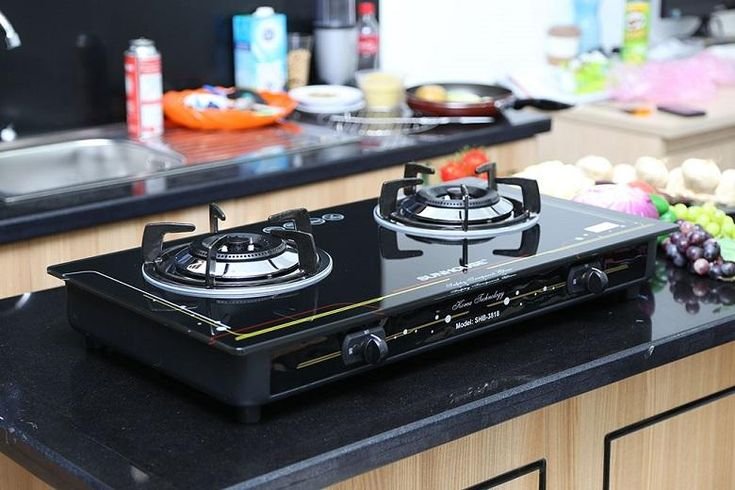
The color of your flame is like a diagnostic tool. Here’s what each color means:
| Flame Color | What It Means | Action Needed |
|---|---|---|
| Steady blue | Healthy, correct combustion | No action needed |
| Blue with yellow tips | Slightly rich fuel mixture | Clean burner ports |
| Mostly yellow/orange | Incomplete combustion, dirty burner | Deep clean required |
| Red or orange | Heavy contamination or salt particles | Clean immediately |
| Flickering/unstable | Moisture, blockage, or low pressure | Inspect all components |
Your goal is a steady, even blue flame. If you’re seeing anything else, one of the five repair ideas above likely applies.
Maintenance Schedule to Prevent Uneven Flames
Prevention is always easier than repair.
Here’s a simple schedule you can follow to keep your gas stove in top shape:
| Task | How Often |
|---|---|
| Wipe burner caps after cooking | Daily |
| Remove and wash burner parts | Every 2–3 weeks |
| Deep clean burner ports | Monthly |
| Check cap alignment | Monthly |
| Inspect igniter for buildup | Every 2–3 months |
| Check gas valve and hose | Every 6 months |
| Professional service check | Once a year |
Sticking to a routine prevents most of the problems covered in this article before they ever arise.
Common Questions About Gas Stove Flame Problems
Q: My gas stove flame keeps going to one side. Why?
A: This is almost always due to a clogged burner port or a misaligned burner cap. Deep clean first, then check the cap alignment. Either one of those two fixes solves the problem for most people.
Q: Is it okay to work on a gas stove myself?
A: Yes — for surface-level repairs like cleaning, drying, and realigning. First turn off the gas and unplug the stove. When it comes to anything involving gas pressure, valves, or internal parts, get a professional.
Q: Why is my flame yellow instead of blue?
A: A yellow flame is an indicator of incomplete combustion. The burner ports are probably clogged, restricting proper airflow. A thorough cleaning usually restores the blue flame.
Q: My burner clicks but won’t ignite. What’s wrong?
A: The igniter is likely dirty or wet. Gently clean it with a dry toothbrush. If the burner was recently wet, wait for everything to dry thoroughly — sometimes overnight — before trying again.
Q: Can a misaligned burner cap be dangerous?
A: A very misaligned cap can create unstable flames that extend outside the normal range, which does create a risk. After every cleaning, always ensure the cap is seated properly.
Q: What is the average lifespan of a gas stove burner?
A: Burner heads and caps can last 10–15 years or longer with proper care. Igniters usually wear out after 5–7 years of regular use.
Q: What if my stove has a pilot light instead of a spark igniter?
A: A pilot light can get blown out by a draft, debris buildup, or a dirty thermocouple. Use a toothpick to clean out the pilot hole and relight it. If it keeps going out, the thermocouple may need replacement.
Wrapping It All Up
An uneven flame doesn’t need to ruin your cooking — or your day.
This guide covers five gas stove repair basics that will address the overwhelming majority of flame issues you’ll ever encounter. From deep cleaning clogged ports to dealing with moisture, realigning the burner cap, inspecting the igniter, and checking your gas supply — each step is practical, doable, and effective.
Most repairs take less than 30 minutes. Most need nothing more than a toothbrush, some soapy water, and a little patience.
The key is to start simple. Clean first. Align second. Dry everything out. Check the igniter. And if nothing else works, check the gas pressure — or call in a pro.
With proper care and these repair basics in your toolkit, your stove will keep delivering that perfect, even blue flame every time you cook.
Got a flame-related problem not mentioned here? Try working through each of the five ideas in order — chances are, you’ll find the fix before you reach the end.

